
First House / Morrison, Colorado
The place is
part of the work.
Hillside, timber, stone, trees and the traces of earlier uses. A specific setting for a present practice.
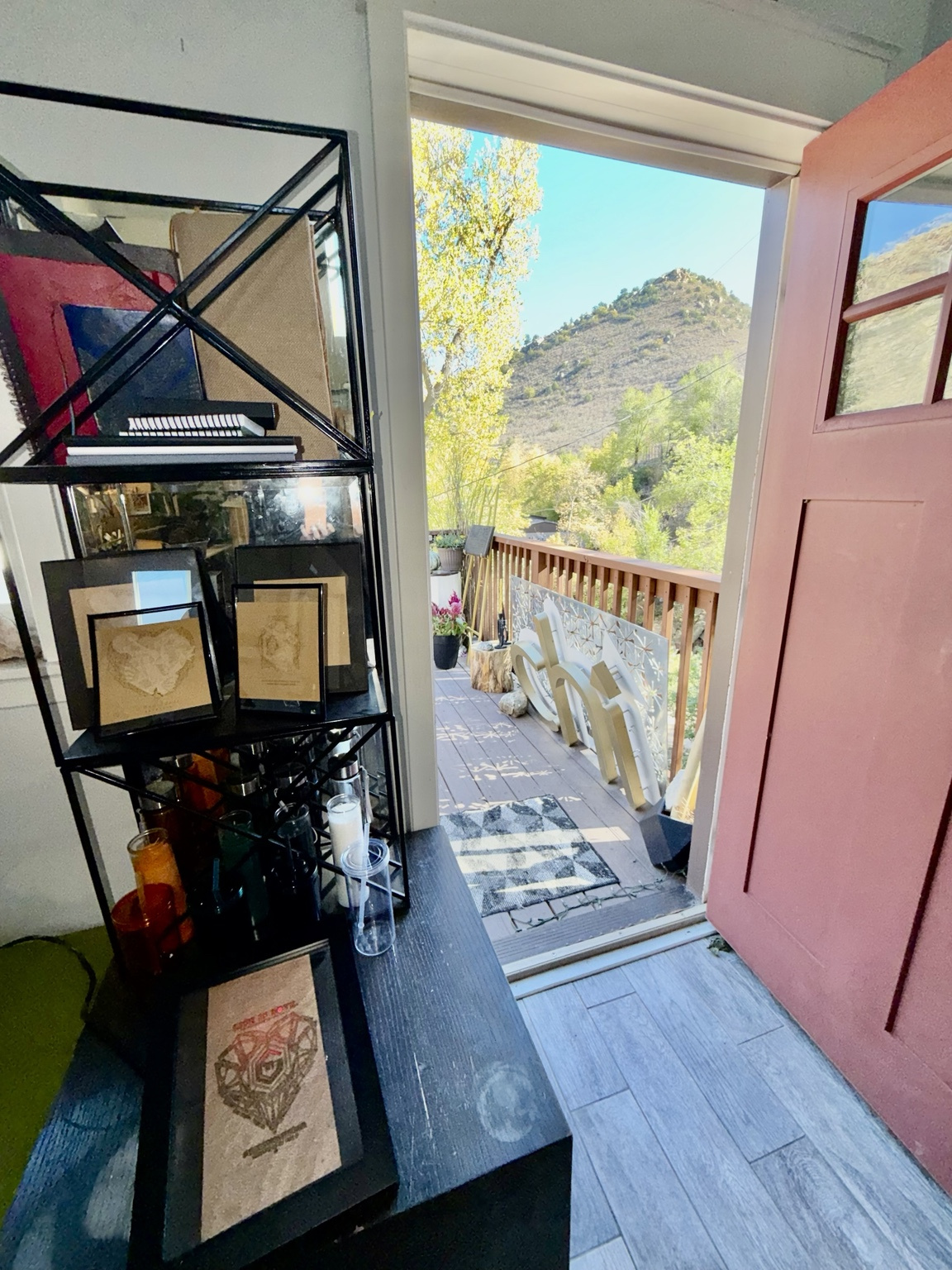
Current base / Unit C
Ask before
you arrive.
120 Bear Creek Avenue, Unit C, Morrison, CO 80465
Public drop-in hours have not been published. Contact Joseph to discuss a visit, collection or access requirement before travelling.
Ask about a visitCurrent stage
A first chapter
that can happen.
- Studio
- Unit C is the current base. Unit B is outside this plan.
- Yard Marketplace
- Owner permission is confirmed. A working fit study is complete. The boundary-fit site plan and operating details requested by the Town on October 22 are being prepared; public dates remain unconfirmed.
- Basement
- Owner permission covers workshop/storage and operational support. Public instruction and occupancy require separate confirmation.
- Access
- The basement entrance is reported level at ground level. This does not establish the whole site’s accessibility. Ask about the exact route, surfaces, steps, seating and facilities for your intended activity.
Amos House / land & living memory
History before the house
The story of this place did not begin when the house was built. Morrison’s local history identifies 120 Bear Creek Avenue as the Amos House, dates it to about 1873 and records a move back for Highway 8 in 1926. The house, Bear Creek corridor and nearby Red Rocks are distinct places within a much longer landscape history.
A closer look at the work
A small source-and-object display is being developed for First House: one material example, the maker's account of the work and a readable provenance card. The display will take its place within the confirmed visitor layout when its location and access are ready.
The making
has a place, too.
Joseph’s established Golden woodworking shop, equipment and seasoned wood support the developing practice. Material selection follows the object being made.
At First House, owner permission also covers ground-level workshop, storage and operational support. Public teaching and visitor arrangements need their own confirmation.
Arrange a conversation or visitPlace, objects & continuity
The same care.
A different scale.
First House is the setting for G Benincasa’s next chapter in Morrison. Its existing character gives the studio and developing marketplace a daily connection to material, memory and place.
The Hall’s vault project expresses those values through an object: Joseph’s discovery, personal investment, recovery and sustained restoration leadership. Here, the commitment continues through a considered use of a historic setting and attention to the stories it carries.
Explore the Hall’s Vault storyA closer reading / Morrison & Red Rocks
Place and source notes
A name or a date can open a story. We keep its place, source and meaning close by, so that a building date does not stand in for the beginning of the land.
Read the place and source notes
The house and the corridor
Morrison History identifies 120 Bear Creek Avenue as the Amos House and gives a construction estimate of about 1873. It also records a move back for Highway 8 in 1926. These are a published local estimate and relocation account; they do not establish that this was the first house in Morrison. The building address, the Bear Creek corridor and Red Rocks’ formations should each keep their own geographic scope.
Sources: Morrison History / local historical interpretation — Amos House.
Living communities and the naming question
Red Rocks’ official history identifies the amphitheatre land as traditional territory of Ute, Cheyenne and Arapaho peoples. These names refer to living peoples and distinct communities. The Southern Ute Indian Tribe’s own history describes a long relationship with the mountains and wider region. Neither account supplies a verified inherited name for this particular amphitheatre. Our research has not yet verified that exact name or an authoritative pronunciation; the question remains open.
Sources: Red Rocks Amphitheatre / City and County of Denver operator — Red Rocks History; Southern Ute Indian Tribe — History.
What the English names record
The venue’s timeline associates Garden of the Angels with a reported 1870 christening, using the qualification ‘supposedly.’ It records Garden of the Titans as the Walkers’ amusement-park development in 1906. The built amphitheatre’s official opening was 15 June 1941. Those entries describe different events, not a complete sequence of exclusive official names. Neither English garden name has been verified here as an Indigenous translation.
Sources: Red Rocks Amphitheatre / City and County of Denver operator — Red Rocks History.
Reading different rocks
Red Rocks’ sandstone and conglomerate belong to the Fountain Formation, recording sediment deposited about 300 million years ago. Nearby Dinosaur Ridge includes different formations and younger chapters: Late Jurassic dinosaur remains in the Morrison Formation, and Dakota Group tracks from about 100 million years ago. Rock deposition, later uplift and erosion, fossil age and modern scientific documentation are different kinds of dates.
Sources: Red Rocks Amphitheatre / City and County of Denver operator — Red Rocks Geology; National Park Service Paleontology Program, Justin Tweet — Paleontology of Morrison–Golden Fossil Areas National Natural Landmark; Colorado Geological Survey — RockTalk Volume7 Number4.
How this enters the work
We use a clear title, a small meaningful detail and a source that can be followed. G authors the design; people who make, restore or carry knowledge retain their own contribution and credit. We keep personal accounts and any particular sharing conditions with their sources, and correct visible wording when better evidence arrives.
Have a source or correction to share? Contact Joseph through our existing inquiry route.
Share a source or correction